Pistol Phase 2: Malfunctions, Muscle Memory & More
When Your Gun Stops Working, You Need to Keep Working
Phase 1 gave you the fundamentals. Phase 2 is where you learn to function when things go wrong — because in a defensive encounter, they could. A jammed pistol at the wrong moment is not an inconvenience. It’s a life-threatening failure, and it’s entirely solvable with the right training.
This phase introduces the malfunctions you’re most likely to encounter, the reload techniques that keep you in the fight, and the shooting positions that let you use cover and terrain instead of standing exposed. You’ll also begin working at greater distances, expanding the envelope of what you can reliably hit under pressure.
Everything here builds directly on Phase 1. Nothing is abandoned, and nothing is assumed.
Schedule Your Free Consultation Verify your placement and equipment before enrollment.
Why Shorter, Frequent Sessions Work Better
Scheduled once per week for six weeks — 10 hours total.
| Session | Format | Duration | Focus |
|---|---|---|---|
| Day 1 | Indoor Dry Fire | 1.5 hours | Review |
| Day 2 | Indoor Dry Fire | 1.5 hours | New skill building |
| Day 3 | Live Fire Range | 2.0 hours | Application |
| Day 4 | Indoor Dry Fire | 1.5 hours | New skill building |
| Day 5 | Indoor Dry Fire | 1.5 hours | Repetition |
| Day 6 | Live Fire Range | 2.0 hours | Application |
Why six sessions instead of one weekend? Repetition spaced over time builds lasting muscle memory. You practice, rest, return, and build on what you learned. This approach produces shooters who can actually perform when it matters — not just during a single intensive block. [Learn More About Our Scheduling Philosophy]
What You’ll Add
Phase 2 opens with a full review of every Phase 1 concept — safety, accuracy principles, presentation, and your first malfunction drill. From there, we layer on the skills that separate a competent shooter from a capable defender.
Advanced Malfunction Clearance: Moving beyond the basic tap-rack-bang. You’ll learn to diagnose and clear the stoppages that require more than a slap and a rack — the kind that stop most shooters cold.
Tactical Reloading: Reloading without exposing yourself or losing your situational awareness. This is a fundamentally different skill from a speed reload, and it’s the one that matters in a defensive context.
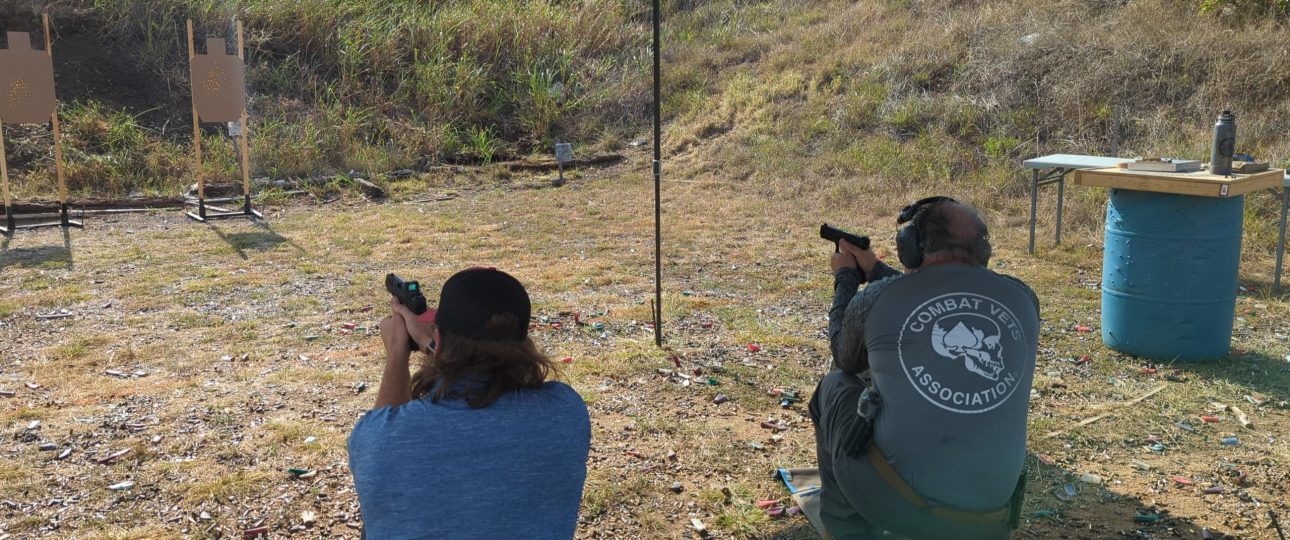
Shooting Positions: Kneeling and prone. Learning to shoot from positions that use cover, stabilize your aim, and keep you a smaller target.
Extended Distance Work: Presentation and engagement out to 15 yards, with accuracy standards that hold up under repetition.
Reinforced Muscle Memory: Every new skill is drilled dry before it’s ever fired live, so the mechanics are automatic before stress enters the picture.
Who Should Take This Phase
- Phase 1 graduates ready to expand beyond foundational skills
- Anyone who has experienced a malfunction at the range and realized they weren’t sure what to do
- Defensive-minded carriers who want their reloads and remedies to be instinctive, not improvised
Placement is determined through your Free Consultation. We’ll verify your current skill level and confirm you’re entering at the right point.
Required Equipment for Training
| Item | Requirement |
|---|---|
| Pistol | Reliable, functional semi-automatic or revolver |
| Holster | Approved, retention-capable holster (inside or outside waistband) |
| Magazines | Minimum of 2 |
| Magazine Holder | Dedicated mag carrier or pouch |
| Gun Belt | Sturdy belt designed for firearm carry |
| Snap Caps | Pack of 5–10 for dry-fire drills |
| Ammunition | 200 rounds |
Don’t have equipment yet? Register for Pistol Basics – Choosing Your Ideal Firearm first. We’ll guide you through selecting a handgun and gear that fits your hand, lifestyle, and budget — so you buy once and buy right.
Prerequisites
Completion of Practical Pistol Course Series: Phase 1.
Experienced shooters may request direct entry via instructor approval during the Free Consultation. We’ll assess your handling, accuracy, and malfunction skills honestly and tell you exactly where you stand.
Still Have Questions?
Do I have to repeat Phase 1 if I’ve trained elsewhere? Not necessarily. Schedule a consultation and demonstrate your skills. If you meet the standard, we’ll place you accordingly.
What’s the difference between a tactical reload and a speed reload? A speed reload trades awareness for time — you dump the magazine and reload as fast as possible. A tactical reload preserves your partial magazine and keeps you ready. Both have their place, and we teach you when each applies.
Will I actually use these skills? Most defensive encounters involving a firearm end without a shot fired. But the ones that don’t tend to involve movement, cover, and equipment failures. That’s precisely what Phase 2 prepares you for.
Is this physically demanding? Kneeling and prone positions require some mobility, but we work with your capabilities. If you can safely get down and back up, you can train here.
Ready to Train Past the Fundamentals?
Phase 1 made you competent. Phase 2 makes you resilient.
Schedule Your Free Consultation
Urban Defense Academy — Liberty Hill, Texas “When survival is the only option!”