Pistol Phase 1: Building Your Foundation
Build the Fundamentals That Protect What Matters Most
Carrying a pistol is really a decision about what you’re not willing to lose. Phase 1 is where the skills behind that decision are built. Here you’ll develop the core handling skills, accuracy principles, and safety habits that form the bedrock of all effective armed self-defense — through structured dry-fire and live-fire sessions that make these vital skills second nature before you ever need them, and before you move into more complex scenarios in Phases 2, 3, and 4.
Whether you’re brand new to firearms, have grown up around them, or haven’t shot in years — this phase solidifies the fundamentals you need to protect what matters most with confidence.
SCHEDULE YOUR FREE CONSULTATION Already trained elsewhere? We’ll assess your fundamentals and verify your equipment. You may qualify to bypass Pistol Basics and enter Phase 1 directly.
Choose Your Schedule: Three Ways to Train
Same course. Same price. Same standards. Every format delivers the identical 10-hour curriculum in the same proven sequence — skills built under dry-fire, indoors first, then applied under live-fire at the range. The only thing you choose is the schedule you train it on.
| Format | Schedule | Structure | Best For |
|---|---|---|---|
| Standard (6-Week) ★ Recommended | One session per week for six weeks | Six sessions: four indoor, two live fire | Students who want weekly rhythm and maximum long-term retention |
| Weekday Intensive | Four consecutive weekday mornings (Mon–Thu) | 3 hrs indoor → 2 hrs range → 3 hrs indoor → 2 hrs range | Students whose afternoons and weekends belong to work or family |
| Weekend Cadence | Once per week on a Saturday or Sunday, across four weekends | 3 hrs indoor → 2 hrs range → 3 hrs indoor → 2 hrs range (e.g., Sundays 9am–12pm indoor, 10am–12pm range) | Students who train best when the week stays untouched |
Available formats vary by session — ask about current start dates during your Free Consultation.
Why We Recommend the Standard (6-Week) Format
Repetition spaced over time builds lasting muscle memory. You practice, rest, return, and build on what you learned. That steady weekly rhythm tends to produce the strongest long-term retention of any format we offer — which is why it’s the one we recommend most when schedules allow.
Standard (6-Week) session breakdown:
| Session | Format | Duration | Focus |
|---|---|---|---|
| Day 1 | Indoor Dry Fire | 1.5 hours | Safety & Handling |
| Day 2 | Indoor Dry Fire | 1.5 hours | Skill Building |
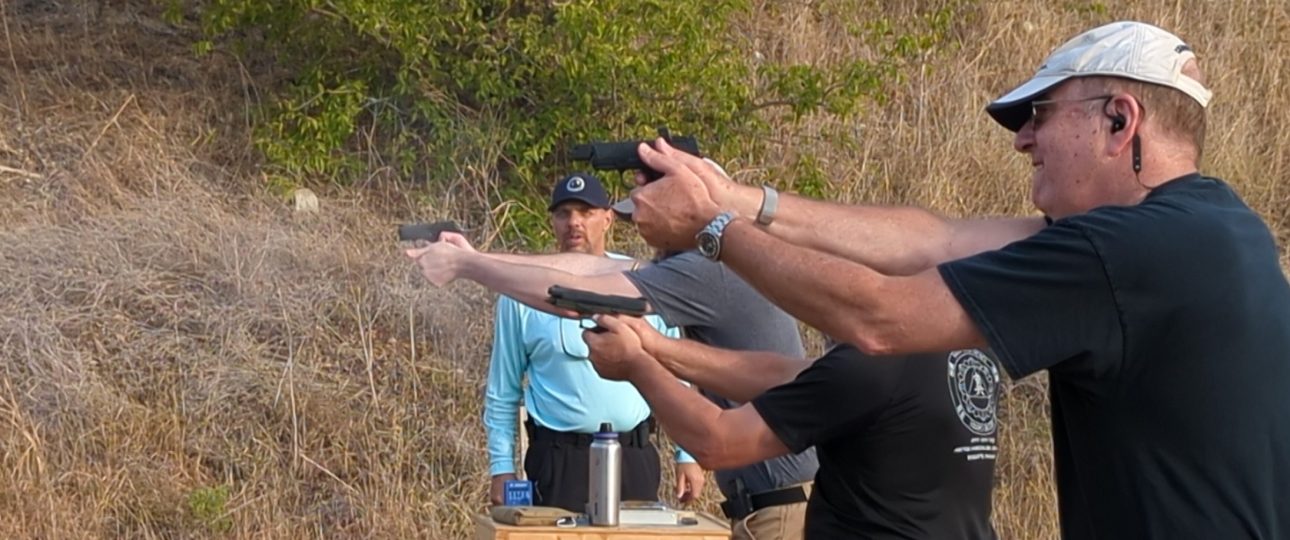
| Day 3 | Live Fire Range | 2.0 hours | Practical Application |
| Day 4 | Indoor Dry Fire | 1.5 hours | Skill Building |
| Day 5 | Indoor Dry Fire | 1.5 hours | Skill Building |
| Day 6 | Live Fire Range | 2.0 hours | Practical Application |
About the Condensed Formats
The Weekday Intensive and Weekend Cadence aren’t shortcuts — they’re the same curriculum, taught by the same instructors, to the same standard. The Weekday Intensive combines sessions into longer morning blocks; the Weekend Cadence preserves the once-a-week rhythm by spreading across four weekends, instead of six. The calendar changes. The curriculum doesn’t.
Every format builds skills under dry-fire, indoors first, then applies them under live-fire at the range — so whatever pace fits your life, you arrive at the same place: Prepared.
[Learn More About Our Scheduling Philosophy]
What You’ll Build
Every skill we teach traces back to a documented origin with a measurable outcome. Nothing is filler.
- Safety & Handling: Basic safety rules, loading/unloading, press checks, and safe firearm manipulation in every context.
- Accuracy Fundamentals: Sight alignment, sight picture, trigger control — the triad that determines every hit.
- Core Manipulation: Low-ready position, pistol presentation, magazine changes, and basic malfunction clearance (tap-rack-bang).
- Shooting Positions: Stable, repeatable postures for accuracy under pressure.
By the end of Phase 1, you’ll have built a robust, reliable foundation for defending yourself and the people who depend on you.
Who Should Take This Phase
- New firearm owners who want proper fundamentals from day one
- Experienced shooters who haven’t trained systematically and want a structured learning path
- Experienced shooters who haven’t taken our Pistol Basics program but may qualify for direct entry into Phase 1 with instructor approval
- Anyone uncertain about their skill level — we’ll assess you honestly during your Free Consultation
If you’re not sure if Phase 1 is right for you, schedule a consultation. We’ll place you where you belong — no ego, no judgment.
Required Equipment for Training
To participate in Phase 1, you’ll need:
| Item | Requirement |
|---|---|
| Pistol | Reliable, functional semi-automatic or revolver |
| Holster | Approved, retention-capable holster (inside or outside waistband) |
| Magazines | Minimum of 2 |
| Magazine Holder | Dedicated mag carrier or pouch |
| Gun Belt | Sturdy belt designed for firearm carry |
| Snap Caps | Pack of 5–10 for dry-fire drills |
| Ammunition | 200 rounds |
Don’t have equipment yet? Register for Pistol Basics – Choosing Your Ideal Firearm first. You’ll learn what makes a handgun and gear right for you — fit, function, and lifestyle — so you can make an educated purchase with confidence, once, and get it right.
Prerequisites
Completion of Pistol Basics: Shooting Fundamentals OR instructor approval via Free Consultation.
Everyone begins at Phase 1. There are no exceptions and no skipping ahead, regardless of prior training or background. If you’ve trained extensively elsewhere, you may qualify to bypass Pistol Basics and enter Phase 1 directly — but Phase 1 itself is required for every student entering the Practical Pistol Course Series.
During your consultation, we’ll evaluate your current skill level and confirm your equipment meets safety standards for range training.
Still Have Questions?
I’ve never touched a gun before. Can I still take this? Not directly — Phase 1 assumes you’ve either completed Pistol Basics: Shooting Fundamentals or can demonstrate equivalent fundamentals during your Free Consultation. If you’re starting from zero, begin with Pistol Basics. It exists precisely to get you ready for this series, and it’s the shortest path to being genuinely prepared rather than merely enrolled.
What if my equipment isn’t ready? Tell us during your Free Consultation. We’ll either walk you through what you need to acquire, or point you toward the Choosing Your Ideal Firearm class.
Do the three formats cost different amounts? No. Standard, Weekday Intensive, and Weekend Cadence all deliver the same 10 hours of instruction at the same tuition. Pick the schedule that fits your life.
Which format should I choose? Whichever one you’ll actually show up for. The Standard (6-Week) format is our most popular and offers a weekly rhythm that supports long-term retention — but the best schedule is the one that fits your life, because a course you can attend beats a format you can’t. We’re happy to talk through your situation during your consultation.
Is this enough to feel protected? Phase 1 gives you the foundation. Full defensive capability develops through Phases 2–4. We’ll discuss your goals during your consultation and map out a realistic path forward.
Where do we train? Indoor dry-fire sessions and live-fire range sessions are conducted at our facility in Liberty Hill, Texas.
Ready to Build Your Foundation?
10 hours. Your schedule. A foundation you can trust when it counts.
Schedule Your Free Consultation
Urban Defense Academy — Liberty Hill, Texas “When survival is the only option!”