Pistol Phase 4: CQC, Single-Hand Operations, Advanced Controls
When You Can’t Shoot Normally, You Still Need to Survive
Phase 1 gave you fundamentals. Phase 2 taught you to function when things go wrong. Phase 3 prepared you for multiple threats and low-light conditions. Phase 4 is where you learn to operate when your body or your environment limits what you can do — one-handed shooting, close-quarters scenarios, and control under pressure.
This is the final stage of the core series. It integrates everything you’ve learned into complex, realistic scenarios that demand adaptive thinking. Strong-hand-only, weak-hand-only, point-shooting methods, rapid presentations under time constraints — these are the skills that keep you functional when ideal conditions don’t exist.
Everything is built on the foundation of Phases 1, 2, and 3. None of this works if the foundation isn’t solid.
[Schedule Your Free Consultation] Verify your placement and equipment before enrollment.
Why Shorter, Frequent Sessions Work Better
Scheduled once per week for six weeks — 10 hours total.
| Session | Format | Duration | Focus |
|---|---|---|---|
| Day 1 | Indoor Dry Fire | 1.5 hours | Review |
| Day 2 | Indoor Dry Fire | 1.5 hours | New skill building |
| Day 3 | Live Fire Range | 2.0 hours | Application |
| Day 4 | Indoor Dry Fire | 1.5 hours | New skill building |
| Day 5 | Indoor Dry Fire | 1.5 hours | Repetition |
| Day 6 | Live Fire Range | 2.0 hours | Application |
Why six sessions instead of one weekend? Repetition spaced over time builds lasting muscle memory. You practice, rest, return, and build on what you learned. This approach produces shooters who can actually perform when it matters — not just during a single intensive block. [Learn More About Our Scheduling Philosophy]
What You’ll Master
Phase 4 opens with a full review of every Phase 3 concept — safety, accuracy principles, malfunction clearance, tactical reloads, concealment draws, low-light engagement, and multi-threat prioritization. From there, we layer on the controls that complete your core training.
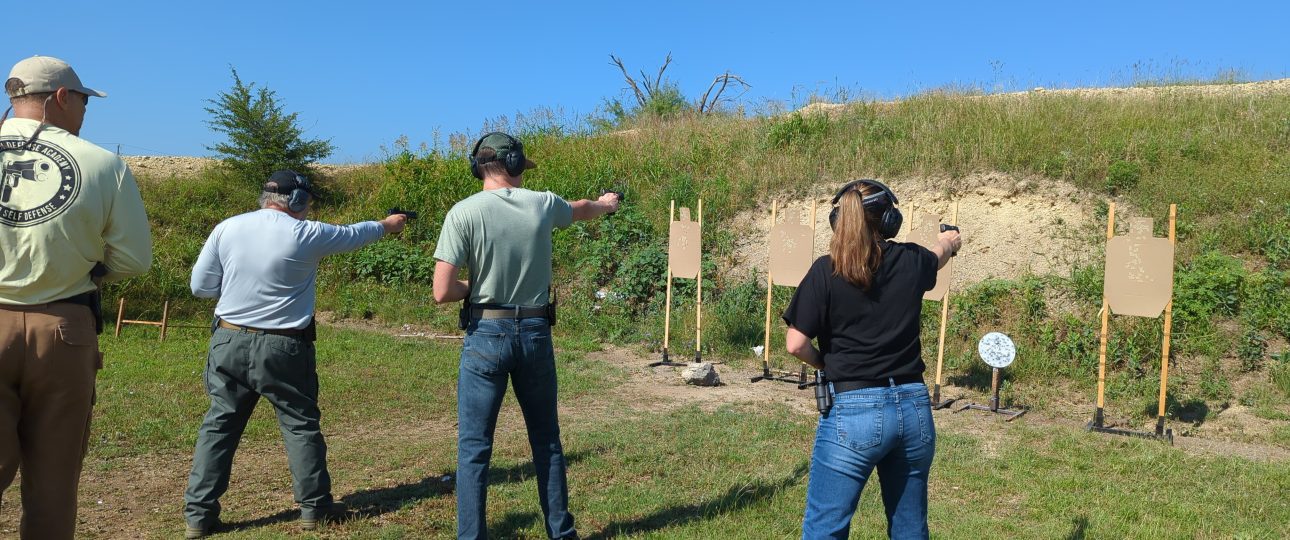
Single-Hand Operations: The heart of this phase. Strong-hand and weak-hand presentations, charging the weapon one-handed, reloading with limited grip options, and transferring between hands. Injuries, obstacles, and environmental factors rarely wait for convenient timing.
Close Quarters Combat (CQC): Integrated scenarios where distance collapses suddenly. You’ll learn to transition smoothly from precision shooting to immediate defensive action without hesitation.
Trigger Control Under Time Pressure: Timed presentation standards and precision trigger work at varying speeds and pressures. When fractions of a second matter, the hit isn’t the only measure — how fast you delivered it is.
Instinctive Shooting Methods: Close-range firing techniques for situations where sight alignment isn’t feasible. These complement precision shooting, not replace it — knowing which to use and when is part of the training.
Comprehensive Integration: Every skill you’ve built comes together in scenarios that demand real-time problem-solving, not rehearsed routines.
Who Should Take This Phase
- Phase 3 graduates completing the core series
- Defensive-minded carriers who want maximum versatility across unpredictable conditions
- Shooters preparing for the Stay Sharp program’s retention and disarmament work
- Anyone committed to reaching full practical competence with the defensive pistol
Placement is determined through your Free Consultation. We’ll verify your current skill level and confirm you’re entering at the right point.
Required Equipment for Training
| Item | Requirement |
|---|---|
| Pistol | Reliable, functional semi-automatic or revolver |
| Holster | Approved, retention-capable holster (inside or outside waistband) |
| Magazines | Minimum of 2 |
| Magazine Holder | Dedicated mag carrier or pouch |
| Gun Belt | Sturdy belt designed for firearm carry |
| Snap Caps | Pack of 5–10 for dry-fire drills |
| Ammunition | 200 rounds (most students use between 160 and 200) |
| Additional | High-quality flashlight compatible with your carry setup |
Don’t have equipment yet? Register for Pistol Basics – Choosing Your Ideal Firearm first. We’ll guide you through selecting a handgun and gear that fits your hand, lifestyle, and budget — so you buy once and buy right.
Prerequisites
Completion of Practical Pistol Course Series: Phase 3.
There are no exceptions to this requirement. Phase 4 builds directly on Phase 3 skills, and skipping them compromises both your safety and your success in this course.
If you’re an experienced shooter who hasn’t taken Pistol Basics: Shooting Fundamentals, you may qualify to enter Phase 1 directly with instructor approval during your Free Consultation. From there, the series progresses sequentially.
Still Have Questions?
What makes this different from the Stay Sharp program? Phase 4 completes the core curriculum — single-hand operation, close-quarters work, and integration of everything before it. Stay Sharp is ongoing maintenance and expansion: disarmament, active retention under physical contact, and live-fire movement. Think of Phase 4 as the final course; Stay Sharp is where you keep those skills alive.
Is “point shooting” accurate enough for defense? It’s accurate enough for close-range emergencies where sights aren’t an option. We teach it alongside precision shooting, not as a replacement. Knowing when to use each is part of the training.
Can I take Phase 4 if I’m injured or have limited mobility? We adapt training to your capabilities. One-handed shooting is actually a key component of this phase, and we’ll adjust based on your physical condition.
Do I need a weapon-mounted light at this stage? A handheld flashlight remains acceptable for Phase 4. Weapon-mounted lights are covered as an upgrade discussion, not a prerequisite.
Ready to Complete the Core Series?
Phases 1–3 made you capable. Phase 4 makes you adaptable.
[Schedule Your Free Consultation]
Urban Defense Academy — Liberty Hill, Texas “When survival is the only option!”